

How Much Are Yu-Gi-Oh! Cards Worth? The 2026 Price Guide
Found a Yu-Gi-Oh! deck from twenty years ago, or wondering whether that freshly pulled Quarter Century is worth something? The question "how much are Yu-Gi-Oh! cards worth?" has an answer that ranges from a few cents to tens of thousands of euros — and the difference lies entirely in a few details anyone can learn to read. In this 2026 price guide we explain what determines a Yu-Gi-Oh! card's value, which versions are genuinely worth something and how to discover the real price of your collection.
Key Takeaways
|
Question |
Quick Answer |
|---|---|
|
What determines a Yu-Gi-Oh! card's value? |
Rarity, set of origin, edition (First Edition multiplies), condition and demand — competitive or collector-driven. |
|
Which rarities are worth the most? |
Quarter Century Secret Rare, Starlight Rare, Ghost Rare and Collector's Rare are the current era's premium multipliers. |
|
Are old cards always valuable? |
No: set and rarity are what count. But the right cards from the earliest sets — like the Legend of Blue Eyes Ultra Rares — are among the game's most precious. |
|
How do I find the real price? |
By comparing recent actual sales of the same copy (same rarity, set, edition, condition), or with a professional valuation. |
|
Is grading worth it for Yu-Gi-Oh!? |
For prized cards, yes: a high-grade graded card is worth many times the same card raw. |
1. The Five Factors That Make the Price
A Yu-Gi-Oh! card's value always comes from the intersection of five elements, and none is enough on its own.
The first is rarity: Yu-Gi-Oh! has one of the most intricate systems in the sector, and the same card can exist in versions with wildly different values. The second is the set of origin: a card from the historic sets or a low-print-run set is worth more than the same card mass-reprinted. The third is the edition: the "1st Edition" stamp is the game's most reliable multiplier. The fourth is condition, which counts double on cards with pronounced foils like Yu-Gi-Oh!'s. The fifth is demand, which has two distinct engines: competitive (the cards today's metagame requires) and collector-driven (the icons everyone wants, always).
2. The Rarities That Multiply Value
If you've read our complete Yu-Gi-Oh! collector's guide, you already know the rarity ladder. Here we focus on the price effect: which versions turn a common card into a chase card.
The current peak: Quarter Century Secret Rare
The Quarter Century Secret Rare, with its commemorative silver foil, is the premium rarity driving the modern market: on the right cards, the QCSR version is worth many times the standard Secret Rare, and the most sought-after reach significant sums.
The elite rarities: Starlight, Ghost and Collector's
The Starlight Rares (very few per set, brutal pull rates) and the Ghost Rares (with the distinctive three-dimensional "ghost" effect) are historically among the game's most valuable versions. The Collector's Rares complete the high end. On these rarities, condition becomes decisive: complex foils show every tiny flaw.
3. First Edition vs Unlimited: The Stamp That Changes Everything
In Yu-Gi-Oh!, the edition is the detail beginners overlook and experts check first. 1st Edition cards — recognizable by the gold "1st Edition" text under the artwork — belong to the set's first print run and are systematically worth more than the later Unlimited versions, all else being equal.
The gap grows with the set's age and prestige: on modern cards the difference can be modest, but on the historic sets a First Edition can be worth many times the Unlimited. It's the first check to run on any vintage card that passes through your hands.
4. The Yu-Gi-Oh! Cards That Are Genuinely Worth Something: The Categories
Rather than a list of names — which ages quickly — we give you the categories where value concentrates, so you always know where to look.
The vintage of the earliest sets
The Ultra Rares of Legend of Blue Eyes White Dragon (2002), the first international set, are Yu-Gi-Oh!'s Base Set: that set's Blue-Eyes White Dragon and Exodia, in First Edition and high condition, are among the game's most precious cards, with graded copies reaching five-figure sums.
The icons in premium versions
Blue-Eyes, Dark Magician, the Egyptian Gods and the other icons hold value in almost every prized printing: they're the subjects with inexhaustible demand, the equivalent of Charizard in the Pokémon world.
The extreme modern rarities
The QCSRs, Starlights and Ghosts of the most beloved cards — meta staples or icons — are the chase cards of the present, with the most interesting entry window while the sets remain in production.
The promos and event cards
Tournament cards, prize cards and limited-run promos occupy the market's extreme end: rare by definition, with unique-piece stories and values.
Did You Know?
The First Edition Ultra Rare Blue-Eyes White Dragon from Legend of Blue Eyes White Dragon is considered Yu-Gi-Oh!'s "holy grail": in PSA 10 grade it has repeatedly surpassed five figures in documented sales.
5. How to Discover Your Card's Real Price
Once you've identified the card — name, set (the code under the artwork, e.g. LOB-001), rarity, edition and condition — you can look up its value. The golden rule is one: look at recent actual sales, not the prices someone hopes to sell at.
Always compare apples with apples: the same card in a different rarity or edition is a different market. And beware of "by eye" estimates based on the name alone: between a mass-reprinted Dark Magician and one from the historic sets in First Edition there are orders of magnitude. For a whole collection or important pieces, the most solid path is a professional valuation: we analyze sets, editions and real conditions and give you an honest picture, without inflating or undervaluing.
6. Condition and Grading: Where Value Multiplies (or Vanishes)
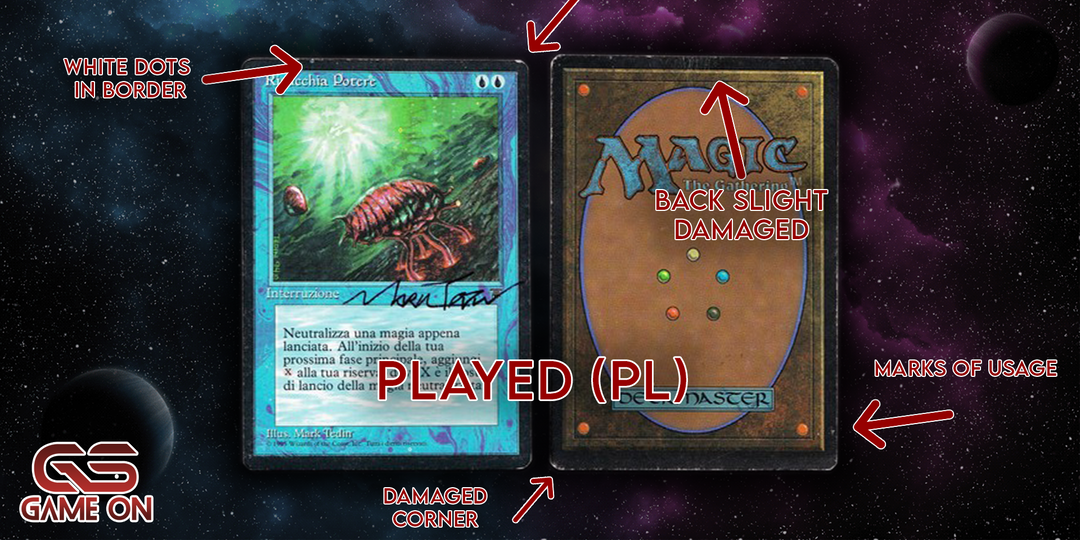
Yu-Gi-Oh! cards are particularly demanding on condition: the pronounced foils of the high rarities highlight scratches and marks that would go unnoticed on other cards, and the dark card back shows every bit of edge whitening. Before dreaming of numbers, examine your card under strong light: corners, edges, surface and centering.
For prized pieces, professional grading (PSA, BGS) is the step that certifies condition and authenticity and maximizes value: the gap between a raw card and the same one in high grade can be enormous, and in Yu-Gi-Oh! — where counterfeits of the historic pieces have circulated for years — the slab is also a guarantee for the buyer. Our grading service with Beckett handles the entire process, and among our graded Yu-Gi-Oh! cards you'll find already-certified copies.
7. The Mistakes to Avoid in Valuation
Three traps recur more than any others. The first: confusing "old" with "valuable" — most cards from the early 2000s are common and worth little; it's the right rarities from the right sets that make the difference. The second: ignoring the set code — the same Blue-Eyes exists in dozens of printings, and only the code tells you which one you're holding.
The third: overestimating the condition of your own card. "Perfect" to an untrained eye is often Excellent or less by grading standards — and the price difference is substantial. When in doubt, an expert check before selling or buying is worth it: you avoid both selling off an important piece and overpaying for a common one.
Conclusion
How much are Yu-Gi-Oh! cards worth? From a few cents to dizzying sums — and now you know exactly what moves the needle: rarity and set, the First Edition stamp, certified condition and the demand that never sleeps on the game's icons. With these tools you can look at any card, from the deck rediscovered in the basement to the freshly pulled Quarter Century, and understand whether you're holding a memory or a small treasure.
At GS Gameon we assess, grade and select Yu-Gi-Oh! cards every day, from the vintage of the earliest sets to the modern premium rarities. If you want to find out what your collection is worth — or find the card it's missing — we're here, with expertise and transparency.
Note: this article is for informational purposes only and does not constitute financial or investment advice. The values cited refer to indicative market ranges, subject to significant variability. Past performance does not guarantee future results.


Leave a comment