

Where to Buy Collectible Cards Online: The 7 Criteria for Choosing Well (2026)
Buying collectible cards online in 2026 is incredibly easy — and that's exactly the problem. Between generalist marketplaces, improvised sellers, streams of dubious provenance and serious shops, the reliability gap is enormous, and choosing badly costs dearly: counterfeits, inflated conditions, tampered sealed products. In this guide we put down in black and white the seven criteria that separate a shop you can trust from a risk, with a chapter dedicated to the most delicate terrain of all: graded cards. No rankings, no names: just the criteria — then you judge.
Transparency note: this guide is written by a card shop. We won't tell you "buy from us": we give you the criteria to evaluate anyone — ourselves included. It's the most honest way we know to talk about this subject, and we submit to that judgment first.
Key Takeaways
|
Question |
Quick Answer |
|---|---|
|
Where should you buy collectible cards online? |
From specialist shops that guarantee authenticity, declare conditions transparently and have a verifiable reputation on independent platforms. |
|
Marketplace or specialist shop? |
The marketplace wins on selection, the specialist on guarantees, expertise and support: for important pieces, the difference is decisive. |
|
What should you check before buying a graded card? |
The certification number in the grading company's database, real photos of the slab and the seller's reputation: three checks that eliminate almost every risk. |
|
Are sealed products safe to buy online? |
Only if the seller guarantees an intact factory seal: "resealed" products are the sector's most widespread scam. |
|
How do you recognize a truly specialist shop? |
By the services it offers beyond selling: grading, valuations, restoration and expert support are the mark of those who live cards, not just resell them. |
1. Criterion #1 — Guaranteed (and Demonstrable) Authenticity
The first criterion is the most obvious to state and the most violated in practice: every product must be genuine, and the seller must be able to prove it. Counterfeits of single cards — especially vintage and chase cards — are increasingly sophisticated, and "resealed" products (opened, stripped of the best cards and closed again) are the sector's most profitable scam.
What to look for: a declared supply chain (official distributors, not "mixed-provenance stock"), explicit authenticity policies and, for sealed products, a factory-seal verification protocol. For our part, to show where we stand, we apply a Factory Sealed check on every incoming lot: if a seal doesn't convince us, the product doesn't go on sale. Any serious shop should be able to explain its own equivalent.
2. Criterion #2 — Conditions Declared, Not Implied
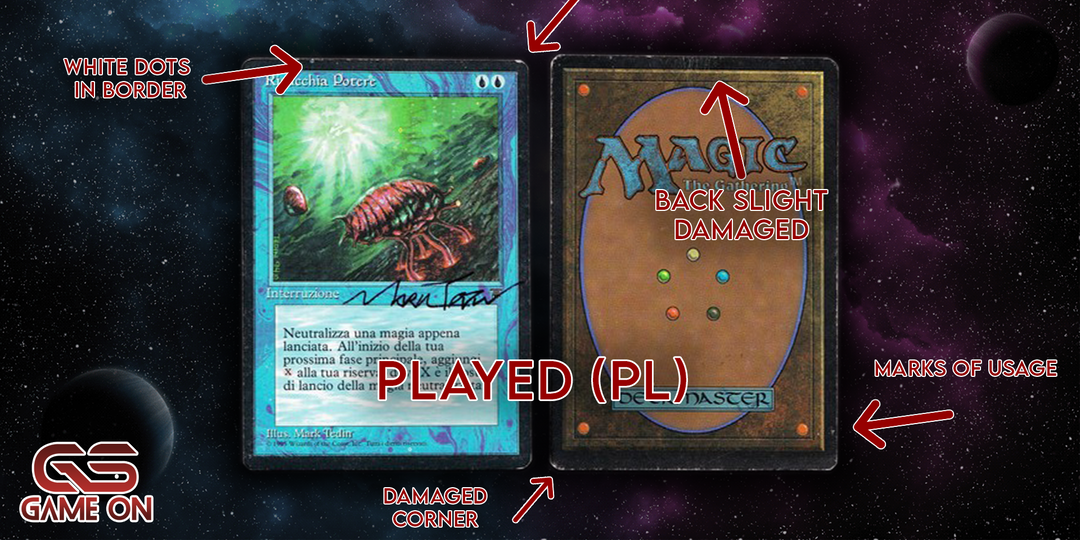
The second discriminator is transparency on conditions. A "Near Mint" card for a hasty seller can be "Excellent" (or worse) by a serious standard — and the value difference is substantial. The reliable shop declares conditions with explicit criteria and, for valuable pieces, provides real photos of the specific copy, not stock images.
The practical test: ask for photos of a card you're interested in. Those who provide them without hesitation have nothing to hide; those who stall are already giving you their answer. On our high-end listings, real photos can be requested directly — and it's a test we invite you to run on anyone, us first.
3. Criterion #3 — Verifiable (Not Self-Proclaimed) Reputation
Anyone can write "sector leader" on their own homepage. The reputation that counts is the one you can't write yourself: reviews on independent platforms (Trustpilot, Google), sales history on marketplaces, a constant public presence verifiable over time.
The strong signals: a substantial volume of reviews with a high rating and — above all — shop replies even to critical reviews, because that's where you see how it treats customers when something goes wrong. The weak signals: few reviews, all perfect; social profiles born yesterday; no trace of the seller outside its own site. For our part: 4.8/5 across more than 240 verified reviews, all public and consultable — here's who we are and where to verify them.
4. Criterion #4 — Shipping by Collectors, Not Warehouse Clerks
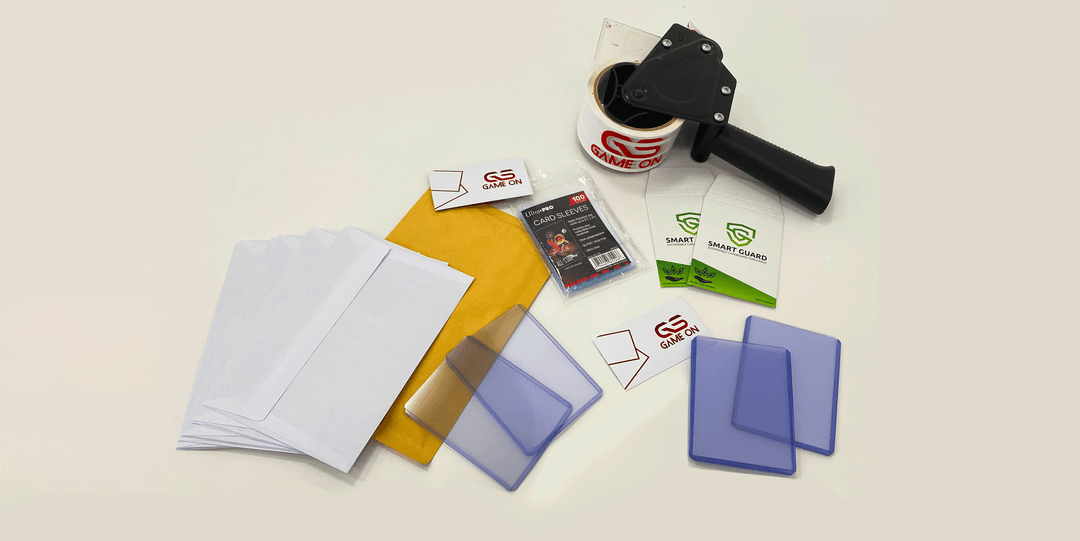
A perfect card shipped badly arrives ruined — and at that point guarantees are worth little. The criterion: packaging designed for cards (rigid protections, anti-humidity materials, properly sized boxes), declared fulfillment times and tracking always included.
For those buying from abroad or purchasing important pieces, insurance on high-value shipments and a clear policy on customs and returns matter too. Our standard: fulfillment within 24 business hours, protective packaging on every order and free shipping over €250 across Europe. But the point isn't what we do — it's that any serious shop must be able to tell you exactly how your card will travel before you pay.
Did You Know?
Every graded card has a certification number registered in the grading company's public database (PSA, Beckett): checking it takes thirty seconds and is the most effective — and most ignored — anti-counterfeit control in the entire sector.
5. Graded Cards: The Terrain Where the Criteria Become Everything
If the criteria above matter for sealed products, on graded cards they become the only thing that matters. A graded card concentrates value, and where value concentrates, so do risks: counterfeit slabs, manipulated labels, invented certifications. Buying graded requires a seller who lives off graded cards — not one who treats them as just another product category.
The three non-negotiable checks
First: the certification number must match in the company's public database, card and grade included. Second: real photos of the slab — front, back and label — because the case has a condition too. Third: the seller's demonstrable expertise on grades, populations and the market, measured by one simple question: can they explain why that card has that grade and that price?
Where we stand (facts, not adjectives)
Graded cards are the heart of our specialization, and we say it with verifiable facts: we're an official Beckett Grading Services partner for submissions from Italy, we run an in-house restoration and pre-grading analysis lab with digital microscopy, and we curate one of Europe's broadest, most cross-game selections of graded cards — from Pokémon to One Piece, from Yu-Gi-Oh! to the emerging games — with shipping across the continent. We don't hide the ambition: to become Europe's reference point for buying, selling and certifying graded cards. Judge us by this guide's criteria.
6. Criterion #5 — The Services Beyond Selling
There's an indicator almost nobody considers that actually says everything: what the shop can do besides selling. Those offering grading services, collection valuations, professional restoration and consulting are demonstrating — with facts — expertise a simple reseller doesn't have, and a long-term interest in the relationship with you.
It's why, in our case, you'll find the grading service with Beckett, collection valuation and conservative restoration: they aren't "extras," they're proof of craft. When evaluating a shop, always ask yourself: if tomorrow I wanted my cards certified or valued, could they help me?
7. Criteria #6 and #7 — Specialization and Real Presence
The last two criteria travel together. Specialization: a shop that lives off TCGs knows sets, rarities, reprints and market quirks in a way no generalist can replicate — and that expertise protects you from bad purchases better than any policy. The test: read how it describes products; generic copy-pasted listings mean reselling, contextualized ones mean advising.
Real presence: a verifiable physical location, a displayed VAT number, active channels where the shop shows its face — from live streams to sector events. A seller who opens packs on camera twice a week and meets customers at conventions has a reputation to defend every single day; an anonymous website doesn't. Not by chance, we go live every Tuesday and Thursday — and this autumn you'll find us at conventions too.
Conclusion: The Final Checklist
To recap, before buying collectible cards online, ask yourself seven questions: is authenticity guaranteed and demonstrable? Are conditions declared with real photos? Is the reputation verifiable on independent platforms? Is shipping designed for cards? On graded cards, does the seller pass the three checks? Does it offer services proving expertise? Does it have a real, verifiable presence? Seven yeses, and you can buy with peace of mind — from anyone.
At GS Gameon we built the shop precisely around these seven criteria, and we keep being measured against them every day: by public reviews, by live streams, by the cards arriving at your door. The ranking of the best isn't written by us — it's written by you, with your choices. All we ask is to have earned a place in yours.


Leave a comment