

PSA vs BGS vs GRAAD: Which Grading Company to Choose (Italy Guide)
Sooner or later every collector reaches the question of questions: PSA, BGS or GRAAD? The three names dominate the graded-card world, but they answer different philosophies — and choosing the wrong one for the right card means leaving value on the table. In this guide we compare them without fan loyalties: what each company certifies, where it excels, which to choose for the card in front of you — and how to grade from Italy with a single request, whichever company you choose.
Key Takeaways
Question |
Quick Answer |
|---|---|
What's the difference between PSA, BGS and GRAAD? |
PSA is the global liquidity standard, BGS the analytical rigor of subgrades with the Black Label myth, GRAAD the European excellence with continental logistics. |
Which company adds the most value? |
It depends on the card: on the global market the PSA 10 is the trading benchmark, while a BGS Black Label can be worth multiples precisely for its rarity. |
Can you grade with BGS from Italy today? |
Yes: BGS submissions are active on our service alongside PSA and GRAAD — and within the same request, each card can go to the most suitable company. |
Which company for a signed card? |
PSA with Dual Grading: the card's grade and the signature's authentication in a single certificate. |
How much does each company cost? |
Price lists vary by company, service and declared value — the exact quote is calculated in real time on our grading form. |
1. Three Companies, Three Philosophies
Grading looks like a single service, but the companies offering it answer different questions. PSA answers "what is this card worth on the world market?": it's the sector's highest-volume company, and its slab is the currency of international trades. BGS (Beckett) answers "how perfect, exactly, is this card?": its four subgrades describe condition like no one else. GRAAD answers "how do I certify well, in Europe, without oceans in between?": it's the continental company that made grading accessible to European collectors.
None of the three is "the best" in absolute terms — there's only the best for that card and that goal of yours. Let's take them one by one, then put them in a matrix.
2. PSA: The Liquidity Standard
PSA's strength is ubiquity: the 1-10 scale, the PSA 10 "Gem Mint" as collecting's most traded grade, extremely deep certified populations and recognition that knows no borders — from eBay to international auctions, a PSA slab sells everywhere with no explanations needed. It's the company that maximizes resellability: if the goal is the global market, the default answer lives here.
PSA also holds the autograph ace: Dual Grading, uniting the card's grade with the signature's authentication in one certificate — for signed promos and event pieces it's the standard the market demands. When to choose it: high-demand modern chases, vintage headed for international resale, signed cards, and whenever liquidity outweighs everything.
3. BGS: Subgrades and the Black Label Myth
Beckett plays a different game: analysis. Every BGS slab declares its four subgrades on the label — centering, corners, edges, surface — with half-points describing the card to the decimal. It's the connoisseur's company, for those who want to know why a card earned its grade, and for high-end modern where the gap between a 9.5 and a 10 lives in the details.
And then there's the one: the Black Label — a perfect 10 across all four subgrades, black label, one of the hardest certifications in all of collecting. On iconic cards, a Black Label can be worth multiples of another company's "plain" 10: it's the Holy Grail for those who won't settle. When to choose it: modern cards in exceptional condition aiming for the absolute peak, and collections where analytical detail is part of the pleasure.
Did You Know?
Beckett's Black Label requires a perfect 10 in all four subgrades — centering, corners, edges and surface. It's one of the hardest certifications to earn in world collecting: on iconic cards, a Black Label copy can be worth many times another company's same 10.
4. GRAAD: Excellence That Speaks European
GRAAD is the continental answer to a historic problem: for decades, grading from Europe meant shipping overseas, with time, costs and customs risks on the collector. The European company flips the equation — short logistics, accessible entry costs, well-crafted slabs and a rigorous assessment method that has earned fast-rising credibility, as our own customers confirm submission after submission.
When to choose it: a collection's first certifications (it's the ideal gateway to grading), mid-range pieces where an American company's costs would erode the margin, and whenever time and simplicity matter. The fastest-growing profile among European collectors — not by chance.
5. The Choice by Card Type: The Practical Matrix
Let's land it, card by card. Modern chase to resell (a Pokémon SIR, a One Piece Manga Rare): PSA for liquidity — the language every buyer speaks. Modern card in exceptional condition, aiming for the peak: BGS, because the Black Label is a prize only it awards. Important vintage: PSA for the global market, with BGS as the analytical alternative. Signed card or event promo: PSA Dual Grading, with no real alternatives. First certifications or mid-range: GRAAD, for Europe's best cost/benefit.
The cross-cutting rule worth more than any matrix: the right company is the one whose premium exceeds its cost — and on borderline cards, our lab's pre-grading analysis tells you what grade to expect before you spend. Full criteria on costs, timelines and process are in the complete grading guide.
6. Grading from Italy: How Our Service Works
Here's the operational part. Our service manages submissions to all three companies — PSA, Beckett/BGS and GRAAD — entirely from Italy, with Beckett submissions back in full operation: you deliver or ship to us, we handle everything — paperwork, international shipping, insurance — with the quote calculated in real time by the grading form. And here's the convenience that makes the difference: each card can go to a different company within the same request — the vintage to PSA, the Black Label candidate to BGS, the mid-range to GRAAD. One technical note: for Beckett, outbound shipping insurance is mandatory (optional for PSA and GRAAD), and the form calculates it for you.
If instead you want the slab without waiting for lab timelines, our graded selection regularly includes PSA, BGS and GRAAD certificates — Black Labels included when they surface. And for important collections, the professional valuation picks the right company with you, piece by piece; above €10,000 in declared value, our dedicated White Gloves management kicks in.
7. After the Slab: Verify, Protect, Buy
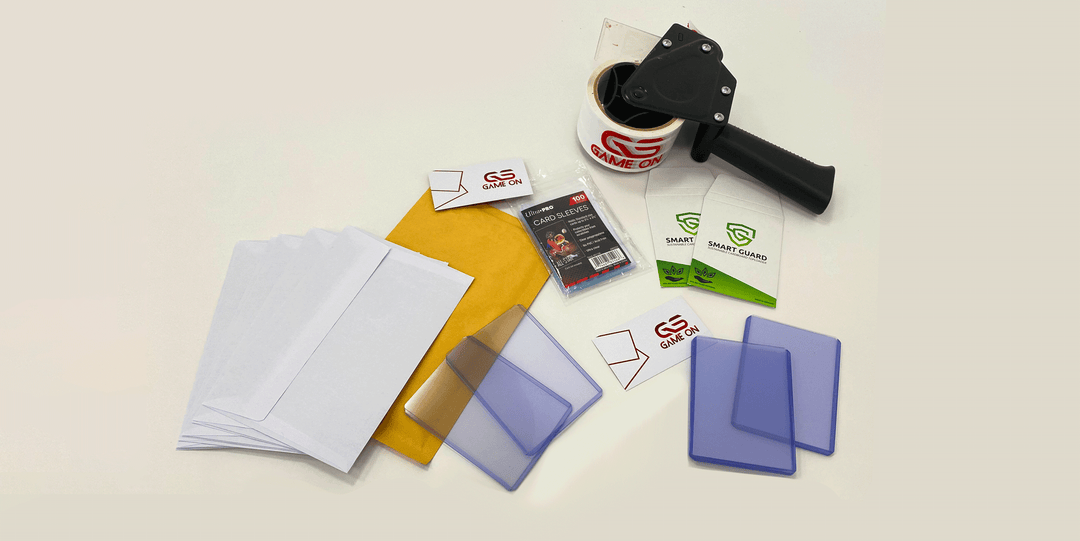
Whichever company you choose, the post-certification rules are shared. Always verify: every slab has a number registered in its company's public database — the thirty-second check that unmasks even counterfeit cases. Protect the slab: the case has a condition too — dedicated bumpers and cases (in our accessories) keep a showcase piece showcase-worthy. Buy with method: for all three companies' slabs, the usual three checks apply — certificate, real photos, verifiable seller.
And for the graded-buying picture market by market, our dedicated guides — graded Pokémon cards and graded One Piece cards — complete this comparison.
Conclusion
PSA for world liquidity, BGS for analysis and the Black Label myth, GRAAD for excellence within Europe's reach: the three companies don't compete on the same question — they answer different ones, and the mature collector uses all three, card by card. You now have the matrix to choose and the rules for moving before and after certification.
At GS Gameon we run grading as specialists: PSA, BGS and GRAAD submissions from Italy with real-time quotes, microscope pre-grading analysis, Dual Grading for signed cards and honest advice on the right company — even when the answer is "wait." Your card deserves the right label: let's choose it together.
Note: this article is informational. Grading companies' price lists, timelines and service availability change over time; the valid quote is always the one calculated by the form at request date. Graded card values depend on grade, population and the market; past performance does not guarantee future results.


Leave a comment