

Magic: The Gathering — The Complete Collector's Guide (2026)
Before Pokémon, before Yu-Gi-Oh!, before everything: in 1993 a mathematician named Richard Garfield invented Magic: The Gathering and, with it, the entire category of trading card games. Thirty-three years later, Magic is still the deepest game in the sector and one of the most fascinating collecting territories in the world — the land of the three-million-dollar Black Lotus, of the Reserved List that locks down the vintage, and of the crossovers that brought The Lord of the Rings and Final Fantasy to the table. In this complete guide we give you the map to collect it with a method in 2026.
Key Takeaways
|
Question |
Quick Answer |
|---|---|
|
Why is Magic special for collectors? |
It's the first TCG in history (1993): its vintage is the sector's most prestigious and the Reserved List guarantees it will never be reprinted. |
|
What's the most valuable Magic card? |
The Alpha Black Lotus: the PSA 10 copy sold for 3 million dollars in 2024 — among the most expensive cards ever traded. |
|
What is the Reserved List? |
Wizards of the Coast's official commitment never to reprint a list of historic cards: the scarcity guarantee that underpins the vintage market. |
|
What drives modern collecting? |
The Commander format, Collector Boosters with special treatments, serialized cards and the Universes Beyond crossovers. |
|
Where can I find selected Magic products? |
In our Magic: The Gathering collection, from Commander sets to the crossovers. |
1. The Father of All TCGs: Why Magic Still Matters
Every trading card game in existence — from Pokémon to One Piece — descends from a 1993 idea: Richard Garfield's, who with Wizards of the Coast created a game where cards are bought in random packs, traded and combined into personal decks. Magic: The Gathering isn't just the first TCG: it's the one that defined the category's collecting rules — rarity, first editions, condition — when nobody yet knew what they were.
For the collector, this primogeniture has a concrete consequence: Magic's vintage is the sector's most prestigious and mature, with valuations consolidated over decades, an international demand base and an infrastructure (grading, auctions, marketplaces) built around it. Collecting Magic isn't chasing a trend: it's taking part in the medium's history.
2. The Absolute Vintage: Alpha, Beta and the Power Nine
It all begins with Alpha (August 1993), the very first printing, followed by Beta and Unlimited. That's where the game's myth-cards live: the Power Nine, the nine cards so powerful they're banned or restricted everywhere — with the Black Lotus as the absolute peak of world collecting alongside Pokémon's icons.
The numbers tell the scale: in 2024 an Alpha Black Lotus in PSA 10 grade sold for 3 million dollars in a documented private sale — among the most expensive cards ever traded in collecting history. But Magic's vintage isn't just the Power Nine: the black-bordered rares of Alpha and Beta, the first basic lands, high-condition copies of any 1993-94 card are museum pieces with a deep, liquid market. And there's a detail that closely concerns European collectors, as we'll see shortly.
3. The Reserved List: The Rule That Locks Down the Vintage
In 1996 Wizards of the Coast made a commitment unique in TCG history: the Reserved List, an official list of historic cards the company pledged never to reprint in any tournament-legal form. Black Lotus, the Power Nine, the original dual lands and hundreds of other early cards are locked forever.
For collecting it's a structural guarantee no other game offers: the scarcity of Magic's vintage doesn't depend on future publishing choices — it's written into the rules. It's why Reserved List cards are considered the sector's most solid assets — and why every discussion of a possible reprint shakes the market: as long as the list holds (and it has held for thirty years), those cards will never increase in number. They can only decrease.
Did You Know?
In 2023, for The Lord of the Rings set, Wizards printed a single worldwide copy of the serialized 1/1 One Ring. It was found in a pack in Canada and acquired by rapper Post Malone for a reported figure above 2 million dollars — the most famous treasure hunt in recent TCG history.
4. Commander and the Formats: Where Modern Demand Is Born
Magic is played in many formats — Standard, Modern, Legacy, Vintage — but to understand modern collecting the key word is one: Commander. The casual four-player format, built around hundred-card decks of all-different cards led by a legendary commander, has become the most widespread way to play Magic in the world — and it has redrawn the demand map.
With Commander, cards ignored by competitive play became highly sought-after staples, and the special versions of the most beloved commanders are chase cards in their own right. It's the logic behind sets like Commander Masters, dedicated precisely to premium reprints for the format. For the collector, the lesson is practical: in Magic, demand isn't made only by tournaments — it's made by the kitchen table, multiplied by millions of playgroups.
5. The Modern Era: Collector Boosters, Treatments and Serialized Cards
Since 2019 Magic has built a collecting-dedicated infrastructure that changed the way packs are opened. Collector Boosters are premium packs designed for those hunting the special versions: particular foils, extended artwork, alternate frames and "showcase" treatments that reinterpret cards with unique styles for each set.
The peak is the serialized cards: individually numbered versions (often a few hundred copies, sometimes just one) that brought the one-of-a-kind logic into Magic. Together with special promos and limited-run drops, they form an ecosystem where every set offers hunting levels for every collector profile — from casual opening to the chase for the numbered grail.
6. Universes Beyond: When Magic Meets Other Sagas
The most recent revolution is called Universes Beyond: the sets that bring external universes into Magic. The precedent that made history is The Lord of the Rings: Tales of Middle-earth (2023), the set of the legendary 1/1 One Ring; its successor did even better — the Final Fantasy set (2025) became the best-selling in the game's history, followed by the Marvel universe crossovers.
For collecting, Universes Beyond has a precise effect: it brings new audiences into Magic — fans of Tolkien, of video games, of comics — who buy out of passion for the guest saga, adding layers of demand the game never had. The prized versions of these sets' most beloved characters are born with two pools of collectors behind them.
7. Collecting Magic Today: Condition, Languages and How to Start
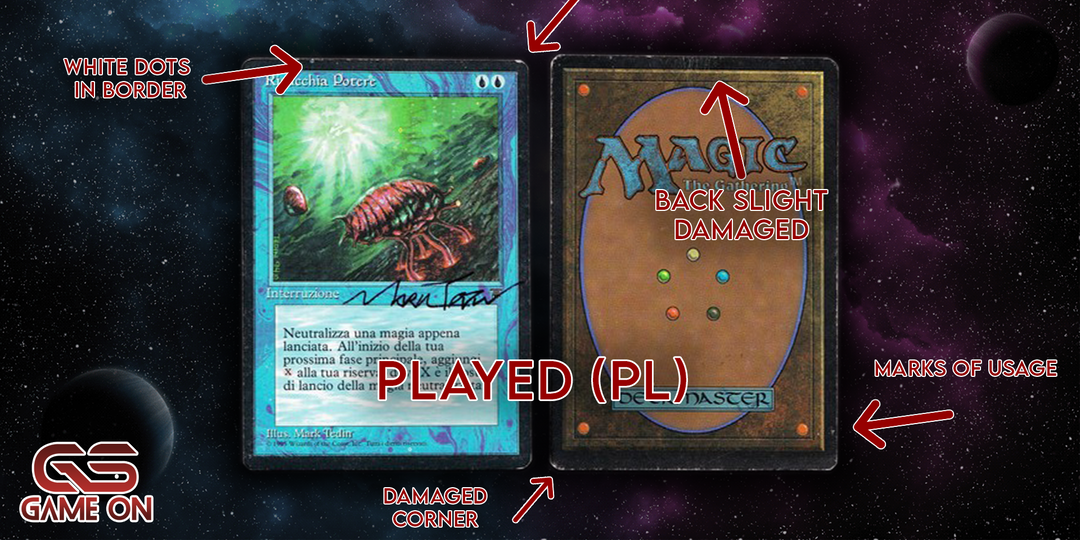
The operating rules mirror those of every mature TCG — with two specifics. First: on condition, Magic's vintage is merciless (the '93-'94 cards have thirty years of lived life) and grading is the de facto standard for important pieces: in our complete grading guide you'll find costs and criteria. Second, a European angle: the black-bordered European printings of the '90s — the FBB Revised and the historic Italian edition of Legends — are sought after by collectors worldwide. If you have boxes of vintage European Magic in the attic, a professional valuation can hold surprises.
For those starting today, the sensible path: define your perimeter (a format, a color, an art plane, a Universes Beyond saga), start from modern sets to build the base and climb toward vintage with certified purchases. And as always, buy only from those who guarantee authenticity and declared conditions — the seven criteria of our guide count double on a game with thirty years of market behind it.
Conclusion
From the three-million-dollar Black Lotus to the modern serialized cards, from the Reserved List that locks the past to the crossovers that widen the future: Magic: The Gathering is the game that invented card collecting and keeps defining its boundaries. Collecting it means moving in the sector's most mature market — with the guarantees, the depth and the stories only the founder can offer.
At GS Gameon we select genuine, sealed Magic products, from Commander sets to Universes Beyond crossovers, and we appraise vintage collections — European printings included. Whether you're building your first Commander deck or trying to understand what that box found in the basement is worth, we're here with expertise and transparency.
Note: this article is for informational purposes only and does not constitute financial or investment advice. The values cited refer to documented sales and indicative market ranges, subject to significant variability. Past performance does not guarantee future results.


Leave a comment