

Card Restoration for Pokémon and TCGs: What Can Be Recovered, What Can't and How It Works
There's a question every collector asks when facing a precious but imperfect card: "can it be recovered?". The honest answer is: it depends — and the difference between a legitimate recovery and an alteration that destroys value is the most important thing this article will teach you. Conservative restoration is collecting's least known, most misunderstood service: done well, it can give a card back its true appearance — and its grade points; done badly, it marks the card forever. Here's what can really be recovered, what can't, and how our lab works.
Key Takeaways
|
Question |
Quick Answer |
|---|---|
|
What is card restoration? |
The professional, conservative cleaning and treatment of surface flaws — fingerprints, dirt, residues — without altering the card. |
|
What can be recovered? |
Surface contaminants: fingerprints, grime, adhesive and tape residues, light marks. Everything sitting "on" the card, not "in" it. |
|
What can't be restored? |
Creases, tears, edge and corner whitening, structural damage: intervening there means altering the card — and grading companies notice. |
|
When is restoration worth it? |
Before grading, on valuable cards with surface flaws: a fingerprint can cost a grade point — and real money. |
|
How much does it cost? |
Pricing is tiered on the card's value: the exact quote is calculated in real time on the service page. |
1. Restoration vs Alteration: The Difference Worth Everything
Let's start from the boundary, because that's where the whole game is played. Conservative restoration removes what has settled on the card over time — dirt, fingerprints, residues — returning it to its true state without modifying its structure. Alteration does the opposite: it intervenes on the card itself — trimming edges, recoloring, pressing out creases — to make it look better than it is.
The first is a legitimate, recognized practice; the second is, at best, irreversible damage and, at worst, fraud against whoever buys next. A serious lab works only on the first side of the boundary — and tells you clearly before touching your card, even when the answer is "this flaw can't be recovered".
2. What Can Really Be Recovered
The practical rule: you can recover what sits on the card, not what's in the card. The first group includes fingerprints (the most common flaw on foil surfaces, and one of the most penalized in grading), dirt and surface deposits accumulated across years of binders and boxes, adhesive and tape residues — the classic mark of cards that lived through the '90s — and light marks from contact or surface humidity.
On these flaws, professional treatment makes a difference visible to the naked eye — and even more under the microscope grading companies will use to examine the card. Every intervention still starts from a preliminary assessment of the individual copy: the card's materials, finish and era determine what's safe to do.
3. What Can't Be Restored (and Why We Say No)
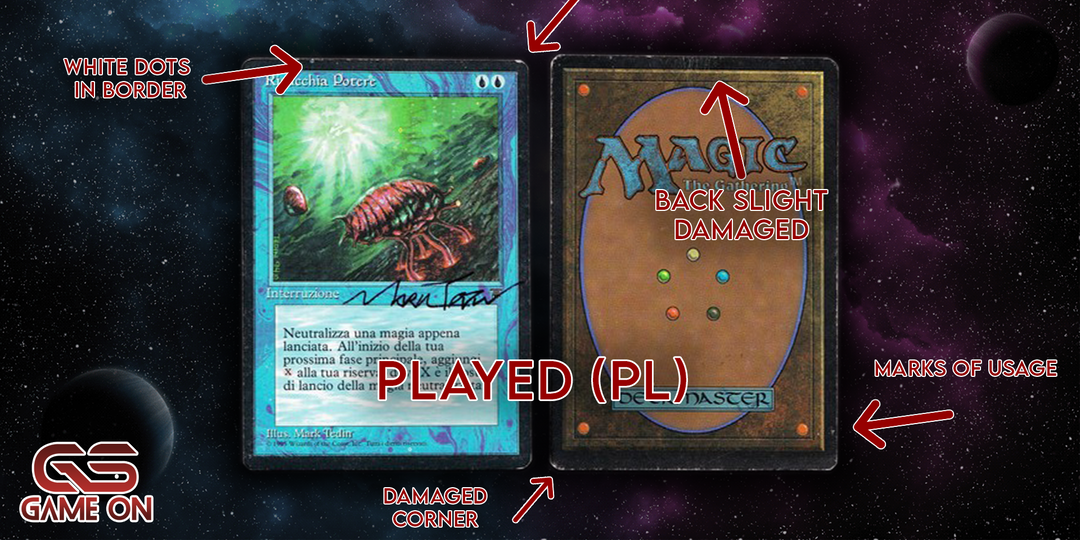
Honesty on this point is worth more than any sale. Creases and wrinkles run through the cardstock's structure: "ironing them out" means altering the card. Edge and corner whitening is ink loss: recoloring it is textbook alteration. Tears, deep dents and liquid damage have compromised the fiber: no honest treatment erases them.
Anyone promising to "fix" these flaws is selling you an alteration — and the card pays the price: grading companies examine every copy hunting precisely for these interventions, and a card recognized as altered loses access to a numeric grade and, with it, most of its market value. Our policy is simple: if a flaw can't be recovered conservatively, we tell you — and the card stays untouched.
Did You Know?
Grading companies examine every card hunting for alterations — trimmed edges, recoloring, pressed creases. A card recognized as altered is marked as such on the label and loses its numeric grade: it's why a bad restoration is worth less than no restoration at all.
4. The Perfect Use Case: Before Grading
The moment restoration pays the most is before a grading submission. The logic is arithmetic: on the grading scale, surface is one of the four parameters — and a visible fingerprint or residue can cost a grade point. On a chase card, the difference between a 9 and a 10 is often measured in hundreds of euros: a professional treatment removing the surface flaw is the best cost/benefit investment of the entire process.
It's why restoration travels in tandem with the pre-grading analysis: we examine the card under a digital microscope with the same criteria the companies use, tell you what grade to expect and whether a treatment can improve the outcome — so you decide with data, not hopes. You'll find both services, individually or bundled, directly in the grading path.
5. How Our Lab Works
The process is built on transparency. One: you request the service from the dedicated page, listing your cards and their value — pricing is tiered on each card's declared value, and the quote is calculated in real time, with no surprises. Two: you deliver the cards to our Scandicci store or ship them insured. Three: we run the preliminary assessment under a digital microscope and confirm what's recoverable — if something isn't, we tell you before proceeding.
Four: conservative treatment, documentation of the result and return — to your door by insured courier or with in-store pickup. And if restoration is the prelude to grading, the card can continue directly toward a submission with our service's active companies, PSA and GRAAD, with no extra steps.
6. When It's Worth It (and When It Isn't)
The criterion is the same as grading: the intervention must be worth more than its cost. It's almost always worth it on: valuable cards with purely surface flaws, "lived-in" but structurally sound vintage, copies headed for grading or sale, and sentimental pieces that deserve to look their best. It's rarely worth it on: common or low-value cards, copies already in excellent condition (the risk doesn't justify the marginal gain) and cards with structural damage — where, as said, the honest answer is that no restoration is possible.
When in doubt, the right starting point is a professional valuation: together we work out what you own, what it's worth and which pieces make economic sense to treat.
7. Prevention: The Best Cure Is Not Needing One
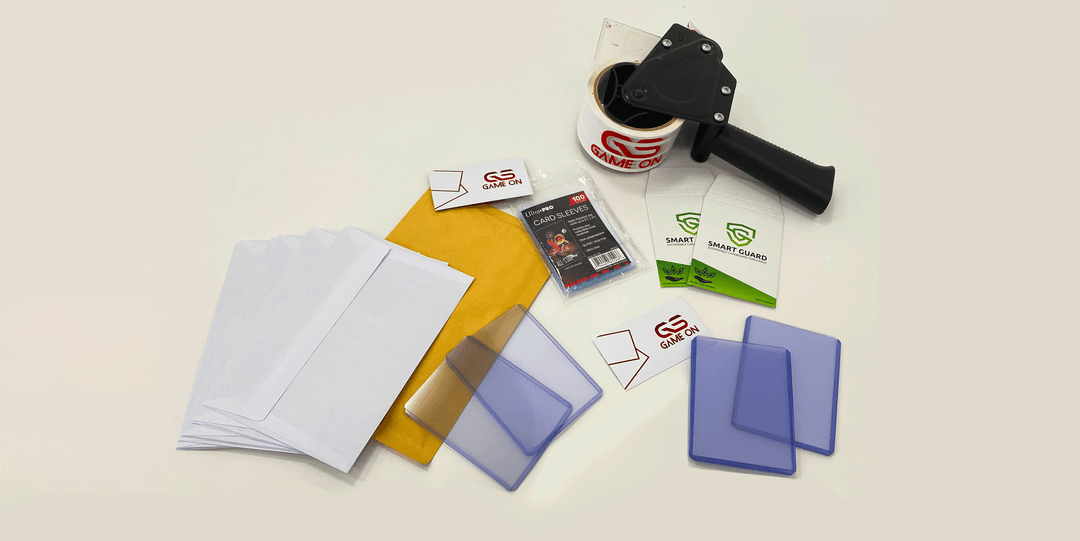
Let's close with the uncomfortable truth: the best restoration is the one avoided. The rules that zero out surface flaws are well known and cost a few euros — sleeves from day one (fingerprints on foils are the #1 flaw we treat), toploaders or semi-rigids for storage, side-loading binders, never adhesives or tape in contact with cards, and dry environments away from direct light.
If you've been collecting for years, though, the past can't be changed: cards from the '90s and 2000s often arrive wearing their history. That's exactly the job the lab exists for — separating the history (which stays) from the dirt (which goes).
Conclusion
Conservative restoration is a craft of boundaries: knowing what can be recovered, admitting what can't and never crossing the line into alteration. Done that way, it gives cards back their true appearance, protects their value and — before grading — can pay for itself with a single extra grade point. Now you can read that boundary too.
At GS Gameon we run one of Italy's few labs dedicated to the conservative restoration of collectible cards: digital microscopy, honest preliminary assessment and treatments only where they make sense. Your card deserves its best look — the real one. Start here.
Note: this article is for informational purposes. The outcome of any treatment depends on the individual copy's condition and is always preceded by a preliminary assessment. Grading companies' examination policies are defined by the companies themselves and may change.


Leave a comment